(8-10 March 2023, Amsterdam)

Justice in International Development
Disentangling, deepening and proposing new pathways
toward just international development
Between 8th to 10th March 2023, around 80 researchers and students from a wide range of backgrounds and disciplines gathered in Amsterdam to engage in critical discussions about the theory and practice of global justice and inclusive development in the world.
The Just International Development Forum was an interactive and co-creative encounter. It featured a rich and diverse programme, including plenary discussions, a world café, sessions in a different format on key themes in international development studies including climate change, migration, women’s rights and urban inequality, “fun” research pitches at a bar, screening and discussion of a powerful documentary “The Territory”, and ample time for conversations. .
The Forum was a success. It brought scholars across generations who work in different places, on diverse topics, with diverse perspectives and different methodologies together to discuss, reflect and bring different perspectives, and imagine ways forward.
Aim and Vision
Development interventions and processes have always been deeply entwined with questions of justice. Critical social scientists have long confronted the unjust implications of an international development agenda that seeks to impose external values, technologies, and modes of governance and the consequent (re)production of inequalities and vulnerabilities.
Echoed by activists leading the social and environmental justice charge on the ground, such critical voices sustain that to be just, development projects must be better attuned to contextual specificities, including asymmetrical power relations and persistent knowledge hierarchies. More recent contributions expand such considerations to question the notion of development altogether, interrogate the means and meanings of justice in high-income regions, and trace how injustice operates and travels across diverse geographical contexts.
The aim of the Forum was to challenge the often taken-for-granted relationship between international development and justice by questioning what is just/unjust about international development or how can development be just?
Programme
Plenary sessions
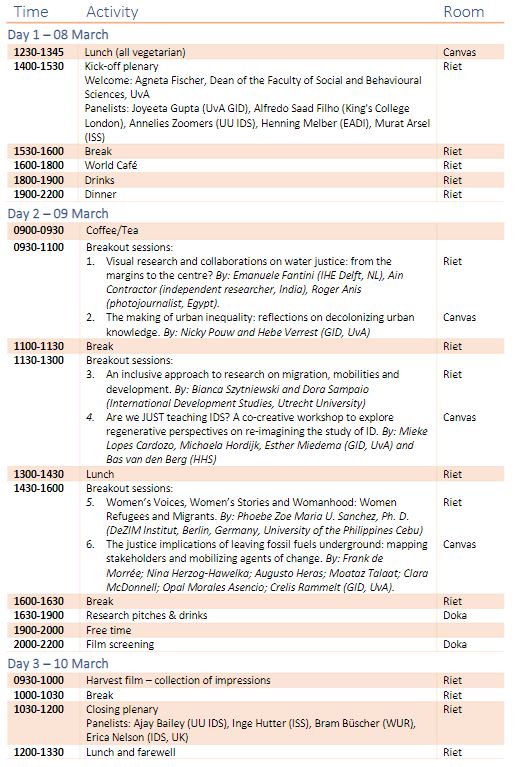
At the opening panel, Joyeeta Gupta (University of Amsterdam), Alfredo Saad Filho (King’s College London), Annelies Zoomers (Utrecht University), Henning Melber (European Association of Development Research and Training Institute), Murat Arsel (International Institute of Social Studies) shared their views on the current state of international development studies. Their sharing set the stage for two days of exciting discussion.
At the closing panel, Inge Hutter (International Institute of Social Studies), Ajay Bailey (Utrecht University) and Erica Nelson (Institute of Development Studies, UK) looked back at the Forum and shared their views on possible ways forward with international development studies and practices.
Breakout sessions
The Forum featured six exciting sessions:
– Visual research and collaborations on water justice: from the margins to the centre? Organised by: Emanuele Fantini (IHE Delft, NL), Ain Contractor (independent researcher, India), Roger Anis (photojournalist, Egypt).
– The making of urban inequality: reflections on decolonizing urban knowledge. Organised by: Nicky Pouw and Hebe Verrest (GID, UvA)
– An inclusive approach to research on migration, mobilities and development. Organised by: Bianca Szytniewski and Dora Sampaio (International Development Studies, Utrecht University)
– Are we JUST teaching IDS? A co-creative workshop to explore regenerative perspectives on re-imagining the study of ID. Organised by: Mieke Lopes Cardozo, Michaela Hordijk, Esther Miedema (GID, UvA) and Bas van den Berg (HHS)
– Women’s Voices, Women’s Stories and Womanhood: Women Refugees and Migrants. Organised by: Phoebe Zoe Maria U. Sanchez, Ph. D. (DeZIM Institut, Berlin, Germany, University of the Philippines Cebu)
– The justice implications of leaving fossil fuels underground: mapping stakeholders and mobilizing agents of change. Organised by: Frank de Morrée; Nina Herzog-Hawelka; Augusto Heras; Moataz Talaat; Clara McDonnell; Opal Morales Asencio; Crelis Rammelt (GID, UvA).
Click here for more info. about the session.
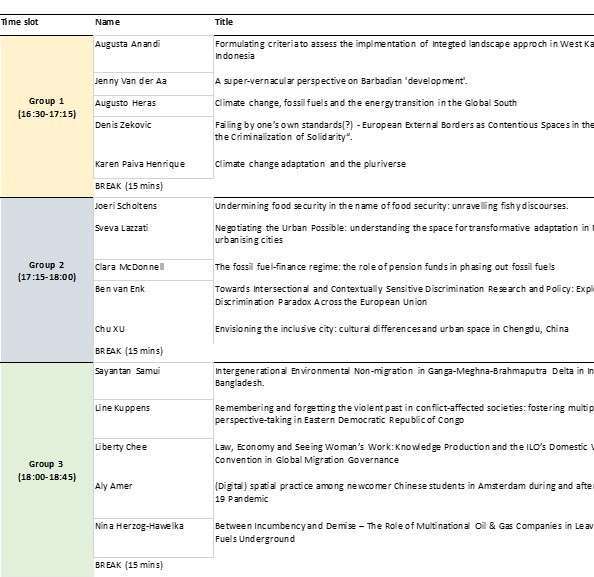
Research pitches
In a more casual and interactive setting, colleagues shared a short (5-min) ‘research pitch’.
International development film screening
In collaboration with Movies that Matter, we met and discussed over a film screening on the film “The Territory”. The film highlights a network of Brazilian farmers seizing a protected area of the Amazon rainforest, while a young Indigenous leader and his mentor must fight back in defense of the land and an uncontacted group living deep within the forest. This film has outstanding cinematography, the story is very touching and emotionally captivating and it touches upon several leading topics of the Just ID Forum. After the film, we engaged with indigenous rights activist Chautuileo Tranamila and Johannes Chinchilla (Movies that Matters) in an inspiring and moving conversation.
Chautuileo Tranamil has worked on a global scale with grassroots communities, especially Indigenous peoples. As a Mapuche-Pewenche herself, she is committed to the well-being of Indigenous communities around the world. Through her work, she is always celebrating the spirit of Indigenous peoples, and honoring their rights, cultural beliefs and local practices. She has studied Political Sciences, International Relations and Conflict Studies in the Netherlands with a focus on Latin America, international public rights and Indigenous peoples. During her work and private life, she has become aware that climate change impacts the Indigenous communities more significantly than others at a global scale. In addition, solutions without Including the voices of the most marginalized are unlikely to be fair, or sustainable.
About us: Governance and Inclusive Development, UvA
Governance and Inclusive Development (GID) is a research group within the Amsterdam Institute for Social Science Research (AISSR), based in the Department of Human Geography, Planning and International Development at the University of Amsterdam. Through research, education and social engagement, we foster a more just, sustainable and inclusive world. We do this by engaging with, examining and challenging dominant patterns and understandings of ‘development’, as a contested notion and its relationship to (in)justice. We critically examine what has been done in the name of ‘development’ in the past and the present, and how the impacts of ‘development’ have been distributed among people and places. These insights allow us to (re)imagine the future of development that is more just, sustainable and inclusive.
Since its inception in the 1990s, the GID group has responded to and set research agendas for understanding the ever-changing field of international development studies. Transformations in political, environmental, economic, social, cultural and technological contexts can contribute to progress, but also to persisting, and often deepening injustices within and between population groups. As an interdisciplinary team, we scrutinise the underlying assumptions and premises of those transformations which exacerbate deepening inequality and injustice, from diverse perspectives and using different research methods. Our work focuses on linking up a range of themes to governance and inclusive development within and across the Global South and North, East and West. In addition, our research applies relational perspectives, highlighting the transnational/local and inter-scalar nature of development processes and their impacts.
Our work advances academic excellence, contributes to methodological innovation and focuses on impact. We work across academic disciplines and engage with stakeholders in sectors beyond academia and integrate diverse knowledges into our work.
For more information, visit our homepage and follow us on LinkedIn.
Get in touch!
If you have any questions regarding the Forum or would like to get in touch with us, feel free to send an email to Maggi Leung: w.h.m.leung@uva.nl.
© 2023 All rights reserved
Banner photo by Vlad Tchompalov via Unsplash, https://unsplash.com/de/fotos/cpAKc-G6lPg

