(27-28 January 2026, Amsterdam)

In this website you will find all the detailed information about the sessions and speakers in the second edition of the Just International Development Forum in 2026.
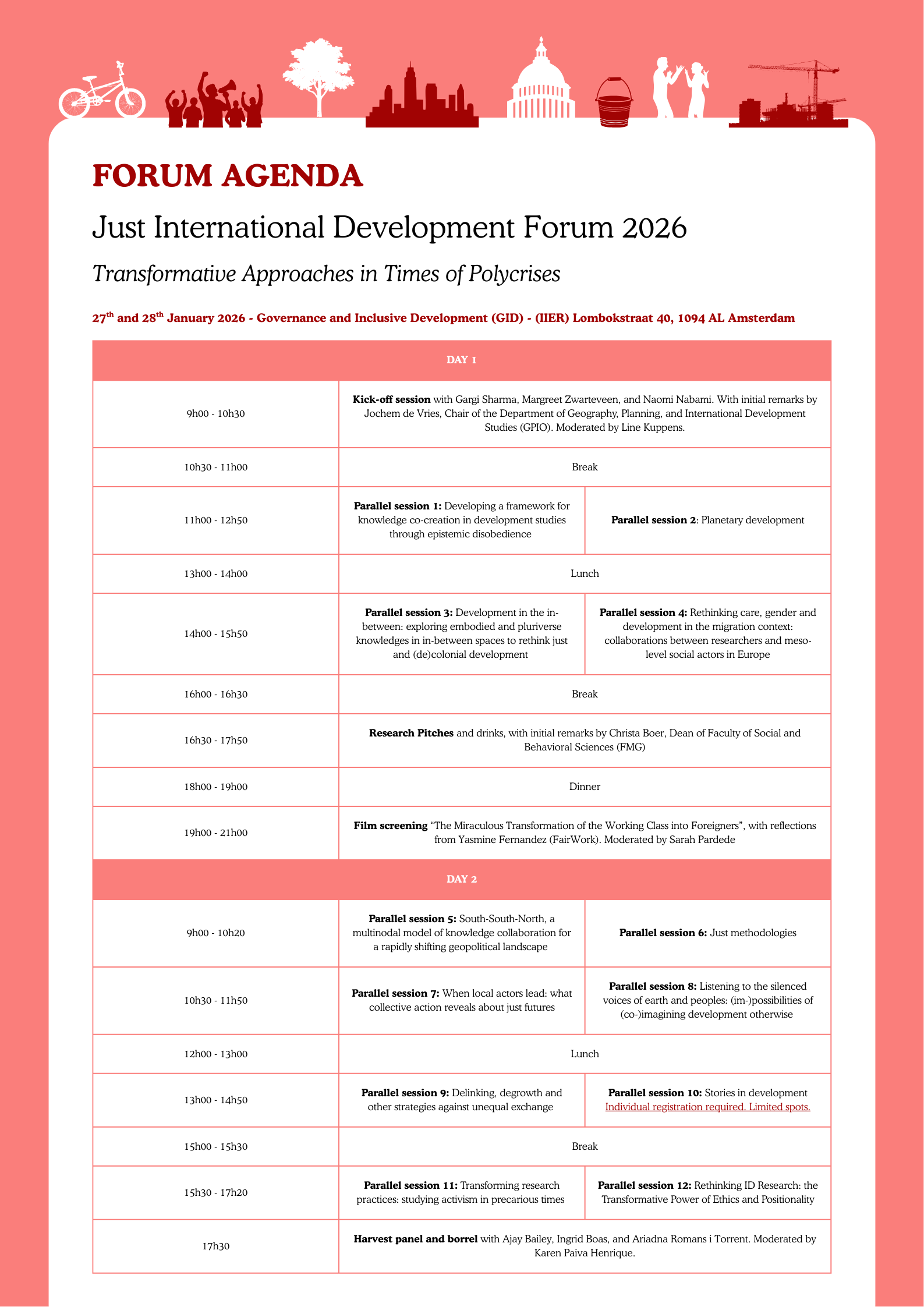
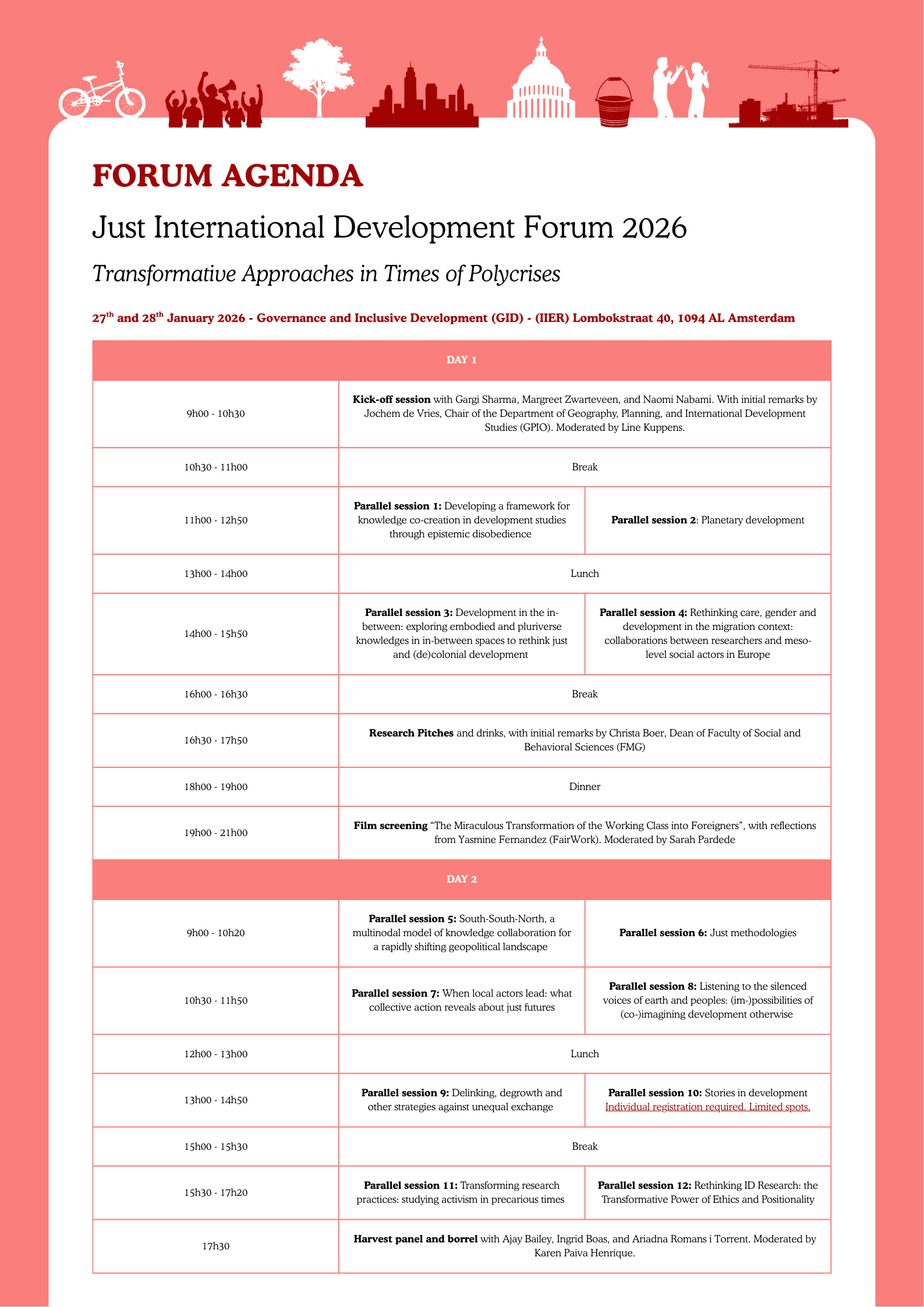
Preliminary Agenda
Since the website does not display the preliminary forum agenda very clearly, please feel free to download it here:
Forum Sessions
DAY 1
KICK-OFF SESSION
Margreet Zwarteveen, Professor of Water Governance, IHE-Delft.
Gargi Sharma, Communications & Development Manager at the CLIMA Fund and Project Coordinator at the critical infrastructure lab at the University of Amsterdam.
Naomi Nabami, PhD candidate, Antwerpen University.
With remarks from Jochem de Vries, Chair of the of the Department of Geography, Planning, and International Development Studies (GPIO).
SESSION 1. Developing a framework for knowledge co-creation in development studies through epistemic disobedience
27th January 2026, from 11h00 to 12h50.
Ana Barbosa Mendes, Erasmus School of Philosophy. Erasmus University Rotterdam
With: Moataz Yakan Talaat, PhD candidate Governance and Inclusive Development. University of Amsterdam
Modernity has been co-constructed through coloniality and scientific, western epistemologies have been instrumental in that co-construction. This co-construction underlies systems of inequality that have engendered many of the intersecting global crises that we are facing today, as well as the construction of development studies and its practices. In order to refuse the violent logics and legacies that are inherent to coloniality, epistemological disobedience is vital. Currently, the spaces we have dedicated to knowledge creation are not conducive to refusing these logics and actively suppress and punish any attempts of epistemic disobedience.
With this session, we aim to imagine a space, shaped by practice-oriented principles, where co-creation of knowledge allows for refusing dominant epistemologies and knowledge hierarchies. We begin by introducing our understanding of knowledge and its goals, relating this understanding to how we have experienced knowledge production as early-career scholars from the so-called Global South, based at universities in the Netherlands. We then invite participants to share, in small groups, their experiences with knowledge production, locating their experiences in their intersecting positionalities and contexts. For this purpose, we will use Keating’s method for building coalitional consciousness to guide these conversations. The conversations include but are not limited to theory, practice and dissemination of development studies, acts of resistance, oppression in the context of knowledge production within different positionalities, methods to build coalition consciousness and possibilities for risk-taking academic and practical norms of international development. We aim to conclude the session by co-creating possibilities for coalitional action as well as principles to foster knowledge cultivation that would shape the knowledge-making space we aim to build. We also wish this session to be a space to foster future collaborations towards building relational spaces for epistemic disobedience.
SESSION 2. Planetary Development
27th January 2026, from 11h00 to 12h50.
Robert Fletcher, professor at the Wageningen University.
With Stephanie Ketterer, Bram Buscher and Sumit Vij, Wageningen University.
This session builds on a growing body of literature adopting and advancing a novel planetary perspective to explore its implications for understanding and influencing how development is unfolding at present. The main thesis of this literature is that the focus on globalization that has dominated discussions of the international world order for the past several decades is increasingly being overtaken by contemporary dynamics that signal the need for a new conceptual frame able to adequately capture them. The planetary, as a condition and way of thinking that recognizes ‘our ineluctable embeddedness in the Earth system, a system we either steward to our benefit or not, but that in either case is indifferent to us even as we depend on it’ (Blake and Gilman 2024:100), potentially offers such a frame. Despite some important initial contributions, however, the implications of this novel perspective for development studies has yet to be systematically explored. This session aims to achieve this in asking how a planetary perspective can help to shed new light on aspects of the contemporary development landscape.
[LUNCH] 13h00 – 14h00
SESSION 3. Development in the In-Between: Exploring embodied and pluriverse knowledges in in-between spaces to rethink just and (de)colonial development
27th January 2026, from 14h00 to 15h50.
Mieke Lopes Cardozo, Associate Professor from the Governance and Inclusive Development, University of Amsterdam.
Line Kuppens, Assistant Professor from the Governance and Inclusive Development, University of Amsterdam
Anthony Heidweiler, Associate Lector in the Amsterdam Academie of Theater & Dance, Dagmar Slagmolen Artistic Director at the Theatre group Via Berlin.
Other invited artists include: Wilbert Slagboom (theatre group DEGASTEN), Laura Cull (Lector of the Academy of Theatre and Dance, Amsterdam and Professor of Performance Philosophy by special appointment University of Amsterdam), Henrike Gootjes (Artez).
Other (so far confirmed) UvA colleagues involved include: Michaela Hordijk, Erdogan Aykaç, Roosmarijn van Woerden, Jonas Carinhas.
This transdisciplinary workshop brings together artists, researchers and educators to explore the “in-between” as a fertile space for re-thinking just and (de)colonial development as a field of study and praxis. Through dialogue and embodied exercises, participants explore the regenerative potential of “in-between” spaces – connecting inner and outer worlds, across disciplines and epistemologies, and across knowledge-creation spaces in university, the arts and society. Together, we will reflect on lived experiences from/in the “in-between” and how inhabiting it more consciously and (co)creatively can open alternative pathways toward rethinking and fostering more equitable futures – within ourselves, our (learning) communities, and the living ecosystems we’re part of. This is a fully interactive workshop, which hopefully will result in a plurality of pathways and potentialities of juster futures. We will ask participants consent to document and record (part of) this workshop, to allow for a co-creative output to be developed if the collective decides this is of added value.
SESSION 4. Rethinking care, gender and justice in migration contexts: Collaboration between academic researchers and meso-level social actors
27th January 2026, from 14h00 to 15h50.
Asuncion Fresnoza-Flot, Université Libre de Bruxelles (Belgium), Maggi Leung, Governance and Inclusive Development, University of Amsterdam; Nicola Chanamuto, University of Amsterdam (Netherlands) & University of Lincoln (United Kingdom);
Other contributors: Giacomo Orsini, Senior Researcher of the Centre for Migration and Societal Change of EURAC research (Bolzano, Italy), Franny Parren, FairWork (Netherlands); Nurhayati, care worker affiliated with FairWork/FNV, the Netherlands; Melanie Joy Escaño, care worker affiliated with FairWork /FNV, the Netherlands; representative from an NGO in Belgium (to be confirmed).
A rich body of scholarly literature on care, gender and migration has proliferated, particularly since the 2000s, with feminist scholars at the forefront. In this body of work, the concepts of care and gender have been widely used to understand migration processes, including their developmental aspects. Studies in this field often involve collaborations between researchers and migrants, researchers and migrants’ family members, and, in some cases, meso-level actors in associative milieus. These collaborations remain under-explored as they typically occur in the context of generating and disseminating data for a specific research project and/or its related activities. Nevertheless, these collaborations can extend beyond the scientific field, particularly when researchers engage in civil engagement or activism, or when non-governmental organisations (NGOs) launch projects targeting migrants and engage with researchers. How do such collaborations unfold in times of polycrises, with the increasing control and criminalisation of migration, austerity measures affecting research and development funding, and criticism of gender-related epistemology? How can researchers and NGO social actors work together to uphold well-being of migrants? What gaps in knowledge and practice does such collaboration reveal?
Our session will address these questions by providing a platform for dialogue and discussion, highlighting the personal experiences of researchers, NGO social actors and migrant workers. We will discuss the following: (i) What does ‘polycrisis’ mean in the context of our work in/related to care in migration contexts? (ii) What kinds of collaboration have been conducted between academics and social actors? What are the challenges and opportunities? (iii) What are the possible ways forward to promote further collaboration between researchers and social actors in times of ‘polycrises’? Participants are invited to share their experiences, reflect on lessons learned and reconsider their conception of care, gender, and justice.
RESEARCH PITCHES. Session 1
This session will start with an special address by Christa Boer, Dean of Faculty of Social and Behavioral Sciences (FMG).
In the first afternoon of the forum, researchers, practitioners, and international development professionals are invited to take part in a 3–5 minute Research Pitch Session. The session offers a platform to present work at any stage, refine ideas and communication skills, and engage with an interdisciplinary audience on justice and development.
Are you considerintg presenting your pitch? Here you can find all the information you need.
[DINNER] 18h00 – 19h00
FILM SCREENING. Movies that Matter
27th January 2026, from 19h00 to 21h00.
Yasmine Fernandez, FairWork.
After dinner, we will have an introduction about the film, a screening and a further discussion with Yasmine moderated by Sarah Pardede.
DAY 2
SESSION 5. South-South-North, a multinodal model of knowledge collaboration for a rapidly shifting geopolitical landscape
28th January 2026, 9h00 – 10h20.
Philippe Peycam, International Institute for Asian Studies, Leiden University.
With: Laura Rabelo Erber, International Institute for Asian Studies, l.rabelo.erber@iias.nl, Martina van den Haak, M.C.van.den.Haak@iias.nl.
The South–South–North (SSN) strategy developed by the International Institute for Asian Studies addresses the urgent need to redesign global knowledge cooperation amid a rapidly shifting and increasingly polarised geopolitical landscape. At its core, the strategy integrates capacity building, institutional development, and knowledge diplomacy, creating a framework that strengthens collaboration across Asia, Africa, Latin America, and Europe while moving decisively beyond traditional North–South paradigms.
By foregrounding equality, reciprocity, and a circulatory model of knowledge exchange, SSN responds to the aspirations of southern societies for greater autonomy and a more balanced, multipolar system of international cooperation. It builds interconnected knowledge ecosystems capable of mobilising universities, civic organisations, local governments, policymakers, and technical practitioners to tackle shared global challenges—from climate justice and urban development to community knowledge and inclusive innovation.
The strategy fosters long-term inter-regional partnerships through fellowships, networks, “ConFests,” and collaborative curricula incorporating alternative pedagogies, enabling southern perspectives to engage equally with European partners and positioning Europe as a non-hegemonic actor amid rising global tensions.
Over more than a decade, IIAS has successfully established academic–civic platforms in Ghana, Tanzania, Thailand, and Indonesia, while expanding engagement to Latin America and other southern regions. By combining capacity building, institutional development, and knowledge diplomacy, SSN nurtures a durable, multi-centred community of actors engaged in circular knowledge exchange, policy innovation, and collaborative problem-solving.
Through this approach, the strategy generates a tangible, expanding network capable of addressing pressing global issues collectively, while reinforcing democratic values, supporting inter-regional dialogue, and strengthening equitable, inclusive global cooperation. SSN exemplifies a practical, inter-regional model for navigating contemporary geopolitical challenges, promoting knowledge sharing, institutional resilience, and strategic collaboration across diverse southern and European actors.
SESSION 6. Just Methodologies
28th January 2026, 9h00 – 10h20.
Jennifer van Beek, PhD Candidate, Governance and Inclusive Development, University of Amsterdam.
With Hebe Verrest and Nicky Pouw, Governance and Inclusive Development, University of Amsterdam, and Dominique Luycks, Masterplan Zuidoost Gemeente Amsterdam and potentially Najah Aouaki, independent urban economist.
Democratic backsliding and persistent prioritization of economic growth, within both low- and high-income countries, trigger exclusionary processes and (re)produce inequities. Divergent experiences and needs become silenced, pushing certain groups (further) into the margins and impairing representation and inclusion in policy practice. We call for a (re)focus on methodologies that adhere to epistemic pluralism and address processes of exclusion, as a foundational component of just development pathways. In this session we want to explore what such methodologies entail (from research design to analysis and dissemination), and question what inclusion and empowerment of diverging voices implies and requires in different contexts. Before collective exploration through an interactive format, the organizers first present a bottom-up methodology to reveal hidden dimension of ill- and wellbeing in Amsterdam in which residents of marginalized neighborhoods participate as authoritative epistemic communities. It discusses successes and challenges in empowering voices through co-creation, social learning and local capacity-building. Participants of the session are invited to critically reflect on the (dis)empowering potential of such approaches and/or share experiences.
SESSION 7. When local actors lead: what collective action reveals about just futures
28th January 2026, 10h30 – 11h50.
Anne-Marie Brinkman, International Institute of Social Studies The Hague, Erasmus University Rotterdam
With Renée van Hoof – Stichting Vluchteling/ The Netherlands Refugee Foundation, Lisa Peterson – International Institute of Social Studies The Hague, Erasmus University Rotterdam. More panelists might be included closer to the date.
This panel will examine how initiatives rooted in local communities of practice and scholarship, bridge global challenges and local responses. By operating at the meso- and micro-levels, they create spaces where divergent visions can coexist productively, fostering collaboration rather than conflict. Connecting horizontally across communities and vertically into national and international debates, local initiatives capture insights that contribute to the conference’s central question: how do we rethink and re-act international development to genuinely construct more just futures rather than reproduce existing power asymmetries under new language?
A first inspiring case invites us to critically rethink the role of international organizations within the humanitarian system. Local action in Sudan offers a bold and practical answer to reimagining the current architecture and an answer to one essential question: “How can we collectively best support those most in need?”
A second case directs attention to how local actors build and practice collective leadership, how they navigate power differentials and construct legitimacy together, to understand how this collective coordination has the potential to transform humanitarian governance from supply-driven to demand-driven. Grounded in a preliminary analysis of local initiatives, this work makes visible what is currently under-investigated: how local actors are already working collectively.
SESSION 8. Listening to the Silenced Voices of Earth and Peoples: (Im-)Possibilities of (Co-)Imagining Development Otherwise
28th January 2026, 10h30 – 11h50.
Tamara Soukotta, International Institute of Social Studies (ISS), Erasmus University Rotterdam.
With: Dr Cynthia Embido Bejeno, International Institute of Social Studies (ISS) of Erasmus University Rotterdam, Venansius Haryanto, Department of Southeast Asian Studies, Universität Bonn, Ignasius Jaques Juru, Department of Southeast Asian Studies, Universität Bonn, Sarah Pardede (University of Amsterdam) and Subandri Simbolon (Radboud University).
Potential contributors: (1) Sunspirit for Justice and Peace, a community-based research and advocacy organisation, based in Labuan Bajo, Indonesia; (2) Floresa.co, independent, critical, award-winning local media based in Flores, Indonesia, actively investigating the violence of Development and advocating for communities’ resistance in the area; Two PhD researchers and activists based in the Netherlands (expressed interests, but have yet to confirmed).
When first introduced, the idea of Development was presented as a proposal to better the world, to bring prosperity to areas and peoples considered backwards in comparison to the Western, Developed world (Lewis 2005). And yet throughout the decades that follow, we see otherwise. Instead of fostering a sense of global solidarity, Development has been a site of exercise of power where coloniality manifested in charity continues to derive pleasure from helping areas and peoples categorised within the Development paradigm as the poor and marginalised.
In the so-called Developing Countries, the ground where Development projects are being implemented, the word Development does not always evoke fond memories. For many (Indigenous) communities, the idea and practice of Development have often trespassed—at times physically bulldozed through—their territories, turned their lives upside down, kicked them out of their homes, forcefully uprooted, relocated and dispossessed them.
On this ground, Development is more often than not experienced as violent projects that enrich the rich and further impoverish those already made to be poor. It has been experienced as a manifestation of Capitalist power that extracts, exploits, and discards. And so the beneficiaries of these processes are seldom the people that Development claimed to serve.
Starting from the position that sees Development as a Modernity Project that exploits, violates, silences and erases, in this panel, we aim to shed light on the darker underside of Development: experiences of the violence of Development. Learning from Maria Lugones’ world travelling (Lugones 2003) as a way to see and listen to experiences of the world (s) beyond our own, we invite stories and rememories (Rhee 2021) of how Development is experienced on the ground. From here, we try to (co-)imagine (im-)possibilities of development and developing otherwise. This panel, therefore, will take the form of a roundtable, meant to be a space of storysharing and conversations involving researchers, pedagogues, (Indigenous) activists, as well as those who inhabit the borders between these roles.
[LUNCH] 12h00 – 13h00
SESSION 9. Delinking, Degrowth and Other Strategies Against Unequal Exchange
28th January 2026, 13h00 – 14h50
Crelis Rammelt, Assistant Professor, Governance and Inclusive Development, University of Amsterdam.
With: Raimon Cardelús Ylla-Català, researcher, and Aljoscha Karg, PhD Candidate at the Governance and Inclusive Development, University of Amsterdam; Julien-Francois Gerber, Associate Professor of Environment and Development at the International Institute of Social Studies (ISS), Marijke van den Broek, master student, Governance and Inclusive Development, University of Amsterdam.
Imperialism and neo-colonialism have returned to both protest slogans and academic debate. This session intervenes in that revival by addressing imperialism’s contemporary form: unequal exchange, a trade-driven transfer of wealth from the periphery to the center. Here, value is extracted covertly through seemingly ordinary market transactions in the so-called ‘even playing field’ of international ‘free-trade’. The theory of unequal exchange reveals how labor exploitation and appropriation of natural resources both stems from the same systemic dynamics and deepens socio-ecological crisis. Therefore, it can strengthen alliances across movements and sharpen strategies of resistance.
One such strategy gaining renewed attention is Samir Amin’s concept of ‘delinking’. Samir Amin defines delinking as the refusal of peripheral countries to “submit national development strategy to the imperatives of globalization” and instead to align external relations to internal development priorities. This more “radical” path implies resource sovereignty, capital controls, debt cancellation, monetary autonomy and lies on a spectrum along with more “reformist” (wage laws, trade certifications), or “structural” (regional trade blocs, alternative monetary systems) paths.
By examining strategies of resistance, this session explores what it might mean to escape unequal exchange. Specifically we focus on how we can challenge and reshape the mechanisms of international trade that currently sustain unequal exchange. For example, how should international trade be organized to facilitate the delinking of peripheral countries? And the other way around, how might delinking influence trade?
The session will include two brief presentations on the above-mentioned concepts of ‘unequal exchange’ and ‘delinking’, followed by a collective workshop in which we examine and propose concrete strategies of transformation, which we will then share and reflect upon together with invited experts from the field (to be confirmed).
SESSION 10. Stories in Development
28th January 2026, 13h00 – 14h50
Karen Paiva Henrique, Governance and Inclusive Development, University of Amsterdam.
With: Ariadna Romans i Torrent, Governance and Inclusive Development, University of Amsterdam.
Stories and storytelling are central to development. Stories help communities translate their aspirations, values, needs, and hopes for a better life to inform development work. Individual and community stories also highlight the limitations, pitfalls, and trade-offs of unsituated development projects as these are implemented on the ground, often with unjust outcomes.
As practitioners, researchers, educators, and students, our personal stories have also been shaped by our encounters with development, in a variety of ways. Sharing these stories can help us in positioning ourselves within space and time, to critically link our development pasts, presents, and futures, across scales and geographies. It can also offer opportunities to reconsider the meanings of and approaches to development, and to decenter and rethink disembodied, violent, and exploitative ideas and ideals of development from the ground up.
This workshop will explore the role of stories and storytelling in shaping just development futures. Participants should come prepared to share a story about a personal encounter with development that has invited them to interrogate/reconsider what development means to them. We will then work together to draw linkages across our stories, identify divergences and key learnings, and craft a collective development story. Ultimately, we will examine how storytelling can provide entry points for transforming development in a time of polycrises, in ways that are inclusive and just.
Places are limited, so make sure to sign up.
SESSION 11. Transforming Research Practices: Studying Activism in Precarious Times
28th January 2026, 15h30 – 17h20
Sumbal Bashir and Lisa-Marlen Gronemeier, International Institute of Social Studies, Erasmus University Rotterdam.
With: Gabriela Villacis Izquierdo, International Institute of Social Studies, Erasmus University Rotterdam, Leandro Garcia Gomez, International Institute of Social Studies, Erasmus University Rotterdam, Jonathan Moniz, International Institute of Social Studies, Erasmus University Rotterdam
The rising right-wing populism and authoritarianism across the world are precipitating the erosion of social and political rights and the expansion of carceral, punitive, military, and border regimes. Simultaneously, new waves of grassroots activism and resistance are emerging across physical and digital spaces, in the “Global South” and the “Global North”. Confronting growing inequalities and multifaceted and interconnected crises, these resistant movements are significantly shaped by multiply-marginalised people who are most affected by the crises. Their resistance is faced with rising online and offline surveillance practices by the state, public and private institutions, corporations, and social platforms, as well as intensifying policing and silencing of dissent. These aim to stifle possibilities for transformative thought and action and pose threats to safety, livelihoods, and lives.
Researchers, scholar-activists, and practitioners working with and studying these movements face many ethical challenges and dilemmas: How do we engage in research on activism and counter-surveillance without damaging the movement? How do we practice solidarity and co-create knowledges in a way that is non-extractive and does not cause harm? How do we attend to Tuck and Yang’s (2014) axiom that there are some forms of knowledge that the academy doesn’t deserve? How do we practice accountability towards communities in struggle?
This session will be organised as a collaborative learning workshop, inviting researchers and practitioners working in difficult contexts to share and exchange best practices and ethical frameworks for studying activism and/or engaging with movements in the times of polycrises. It will also open the space for researchers to share their challenges of navigating these complex ethical dilemmas in research and work with movements.
SESSION 12. Rethinking ID Research: the Transformative Power of Ethics and Positionality
With Ciprian Piraianu, Kathe Ploeger and Jeska de Jong, master graduates from the International Development Studies programme at the University of Amsterdam.
We are Käthe, Ciprian and Jeska, and we are all fresh graduates from the (R)MIDS programmes at UvA. Our master theses focused on multispecies justice, climate adaptation justice, and energy justice in urban and rural spaces across the Global North and South. We are interested in taking session participants on a journey from research topic to research design, exploring ways to decolonise, decentre, reimagine and rethink international development and climate change research. From a student perspective, we also aim to explore what senior academics should consider when guiding students through their early research experiences.
We will first introduce our three respective master theses, the specific ethical dilemmas we faced and how we applied non-conventional strategies related to our positionality. We will then ask the audience to divide into groups to create a research proposal or strategy. They can select their own research theme or get inspired by our case studies. We will also highlight some (ethical) controversies we faced, such as working in one’s country of origin, with post-colonial settings, or marginalized communities. For the second part, we will re-mix the groups, with one person from each group staying behind, so they can transform the original approaches. Finally, we discuss in plenary what changed in their research strategy and design. What are the elements they would keep or change? Are there contradictions with elements or ethical issues we shared? If new insights or dilemmas emerged from the discussion, how would they guide students through them?
We hope to spark an interesting discussion between participants around how we can rethink international development research and our position(s) in it. We advocate for the importance of including (recent) students’ perspectives in the forum, especially on this topic, because we bring fresh perspectives and hope to foster an intergenerational exchange.
HARVEST PANEL AND BORREL
Ajay Bailey, chair in Geographies of Health, Inclusion, and Development
International Development Studies (Utrecht University).
Ingrid Boas, professor at the Environmental Policy Group (Wageningen University).
Ariadna Romans i Torrent, researcher (University of Amsterdam), and Just ID Forum co-organiser.
Moderated by Karen Paiva Henrique, assistant professor (University of Amsterdam), and Just ID Forum co-organiser.
If you have any doubts about our agenda, please do not hesitate to email us at justid@uva.nl.
 JUST International Development Forum